
Views: 0 Author: Site Editor Publish Time: 2026-08-25 Origin: Site
Freeze dried ice cream has evolved from a novelty “astronaut ice cream” product into a growing shelf-stable snack category.
Its crunchy texture, lightweight format, long shelf life, and room-temperature storage make it attractive to retailers, distributors, importers, e-commerce sellers, specialty food companies, and private label brands.
For businesses, however, buying freeze dried ice cream wholesale is very different from purchasing retail products.
A wholesale buyer needs to consider product quality, flavor options, packaging, minimum order quantities, production capacity, food safety, shelf life, shipping, customization, and supplier reliability.
This guide explains everything businesses should know before sourcing wholesale freeze dried ice cream, including how to choose a manufacturer, what questions to ask suppliers, how OEM and private label programs work, and how to prepare for a bulk order.
Wholesale freeze dried ice cream refers to freeze dried ice cream purchased in larger quantities directly from manufacturers, wholesalers, distributors, or B2B suppliers.
Unlike traditional ice cream, freeze dried ice cream does not require conventional frozen storage when properly processed and packaged.
The freeze drying process removes most of the moisture from the product and transforms traditional ice cream into a lightweight, crispy snack.
This creates several advantages for wholesale buyers.
Crunchy and crispy texture
No conventional frozen storage required
Lightweight product format
Convenient transportation
Long shelf life when properly packaged
Suitable for retail and e-commerce
Available in multiple flavors
Suitable for OEM and private label programs
For businesses, these characteristics can make freeze dried ice cream easier to handle than conventional frozen ice cream.
Wholesale sourcing is particularly attractive for companies that plan to sell freeze dried ice cream as part of a larger product portfolio.
Instead of purchasing small retail packs from consumer-facing stores, businesses can work directly with suppliers to obtain larger quantities and potentially customize the product.
Wholesale purchasing generally allows businesses to obtain better unit economics than buying individual retail products.
The final price depends on factors such as:
Product formulation
Flavor
Product size
Order quantity
Packaging
Customization
Shipping terms
Private label requirements
For this reason, buyers should request a detailed quotation based on their specific project rather than relying on a generic online retail price.
One of the biggest advantages of freeze dried ice cream is that it does not require the same frozen cold-chain handling as traditional ice cream.
This can simplify:
Warehousing
Domestic transportation
International shipping
E-commerce fulfillment
Retail distribution
Cosda Group describes its freeze dried ice cream as a lightweight, crispy, shelf-stable dessert snack designed for wholesale, OEM, and private label applications.
Freeze dried ice cream can be particularly attractive for online businesses.
Traditional ice cream requires frozen transportation and storage, which can make nationwide or international e-commerce fulfillment complicated.
Freeze dried ice cream can instead be sold as a packaged shelf-stable snack, making it suitable for:
Online snack stores
Amazon sellers
Specialty food websites
Gift box businesses
Subscription snack boxes
Social-commerce brands
Its unusual texture and novelty appeal can also make it suitable for social media-driven snack businesses.
Wholesale freeze dried ice cream can be positioned in different retail environments.
Potential sales channels include:
Supermarkets
Convenience stores
Specialty snack stores
Gift shops
Museum stores
Tourist attractions
Camping and outdoor retailers
Candy stores
E-commerce platforms
This flexibility allows businesses to develop different product sizes and packaging formats for different sales channels.

Wholesale buyers can choose from standard products or develop customized products with a manufacturer.
Vanilla is one of the most versatile freeze dried ice cream flavors.
It has a familiar flavor profile and can work well for mainstream retail products, gift packs, and novelty snack collections.
Cosda Group currently offers freeze dried vanilla ice cream in a crunchy cube format, with customized packaging and OEM/private label options available.
It can be positioned as:
Premium dessert snacks
Chocolate snacks
Novelty food
Gift products
Private label products
Strawberry is another classic flavor suitable for freeze dried ice cream.
Its fruit-forward flavor can also complement mixed-flavor snack packs.
For private label and OEM projects, buyers may want flavors that are different from standard products.
Depending on the manufacturer's capabilities, customized concepts can include:
Coffee
Matcha
Mango
Blueberry
Caramel
Coconut
Cookies & Cream
Mint Chocolate
Seasonal flavors
Custom flavor development should be discussed with the manufacturer before placing a production order.
Wholesale freeze dried ice cream does not have to be sold in only one format.
Depending on the manufacturer and production capabilities, businesses may consider:
Small cubes are convenient for individual snack packs and retail packaging.
Small bite-size pieces can be suitable for snacking and mixed-flavor products.
Larger formats can create a more substantial dessert-snack experience.
Sandwich-style products can be positioned as premium or novelty products.
Mixed packs can combine multiple flavors in a single retail package.
For B2B projects, product size and format should be confirmed during the sampling and quotation stages.
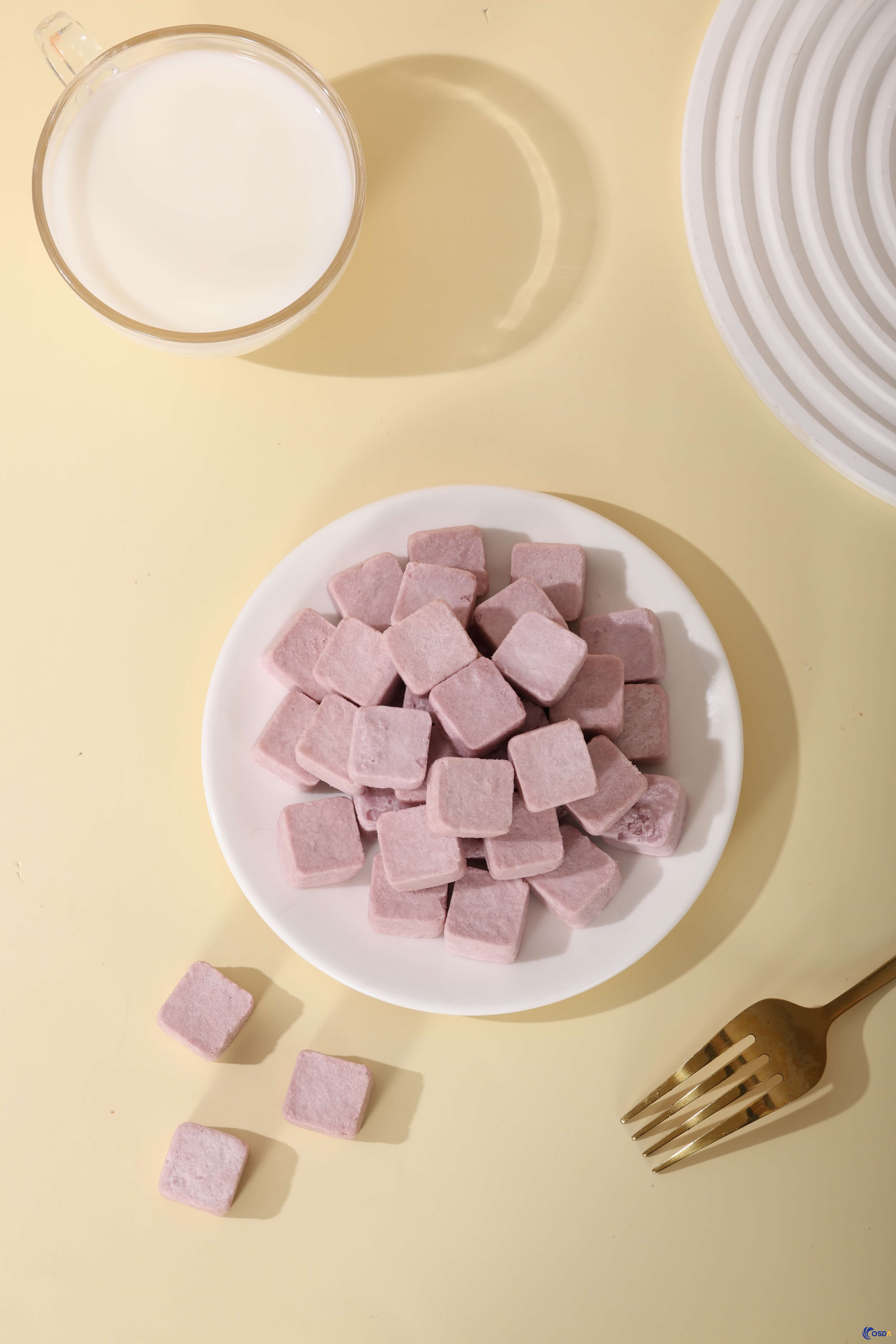
Choosing the right supplier is one of the most important decisions for a wholesale buyer.
The lowest price does not necessarily mean the best supplier.
A reliable supplier should be evaluated across several areas.
Start by evaluating the actual product.
Before placing a large wholesale order, request samples and assess:
Flavor
Crunchiness
Appearance
Piece size
Texture consistency
Packaging quality
For B2B buyers, sample testing is especially important because product quality directly affects customer reviews and repeat purchases.
Ask whether the supplier operates its own manufacturing facility or acts primarily as a trading company.
A direct manufacturer may provide greater control over:
Production
Product specifications
Quality control
Customization
Packaging
Production scheduling
For large or long-term projects, manufacturing capability can be particularly important.
Food safety should be one of the first factors considered when selecting a wholesale supplier.
Ask the supplier for relevant documentation, such as applicable:
Food safety certifications
Product specifications
Ingredient information
Testing reports
Certificates of Analysis where applicable
Traceability information
The exact documentation required will depend on your destination market and product category.
A supplier may be able to provide samples but still lack sufficient production capacity for a growing brand.
Ask:
What is the production capacity?
Can the supplier handle repeat orders?
How are production schedules managed?
Can production scale as demand grows?
For distributors and retailers, stable supply is often more important than a one-time low price.
If you are building your own brand, look for a supplier that can support OEM or private label manufacturing.
Useful capabilities may include:
Custom flavors
Custom product sizes
Custom packaging
Brand labeling
Retail-ready products
Product development
Cosda Group provides OEM, ODM, private label, custom flavor development, and bulk manufacturing solutions for international customers.
International buyers should also evaluate a supplier's export experience.
Ask whether the manufacturer can support:
Commercial documentation
Product specifications
Packing information
Export coordination
Shipping arrangements
This can be particularly important when importing food products across borders.
MOQ means Minimum Order Quantity.
There is no universal MOQ for freeze dried ice cream because it can depend on the supplier and project.
For example, MOQ may vary according to:
Standard or custom product
Packaging type
Printed packaging
Flavor
Product size
Order quantity
Private label requirements
A standard product may have different requirements from a fully customized private label product.
For this reason, buyers should request the supplier's current MOQ based on their exact specifications.

There is no single wholesale price for freeze dried ice cream.
The final cost can be affected by multiple variables.
Different formulations and ingredient costs can influence the final price.
Standard flavors may be more straightforward to manufacture than highly customized flavors.
Larger pieces may require different processing and packaging specifications.
Freeze drying is an energy- and equipment-intensive manufacturing process, and processing requirements can vary between products.
Packaging can have a significant impact on the final cost.
For example:
Standard bulk packaging
Individual retail packaging
Custom printed bags
Gift boxes
will have different cost structures.
Larger production runs may offer better unit economics.
For international buyers, the final landed cost can also include:
Freight
Insurance
Customs-related costs
Import duties
Local transportation
Therefore, buyers should compare total landed cost, rather than looking only at the factory unit price.
Packaging is extremely important for freeze dried products.
The biggest packaging concern is moisture.
Once freeze dried ice cream absorbs humidity, it can gradually lose its characteristic crunchy texture.
Commercial packaging should therefore provide an appropriate moisture barrier.
Possible packaging formats include:
High-barrier pouches
Stand-up bags
Heat-sealed bags
Individual snack packs
Multi-pack bags
Bulk bags
Custom printed retail packaging
Gift boxes
Cosda Group offers customized packaging solutions for its freeze dried ice cream products, including retail and private label applications.
Wholesale and private label are related but different business models.
Feature | Wholesale | Private Label |
|---|---|---|
Brand | Supplier's or standard product | Buyer's brand |
Packaging | Standard | Customized |
Flavor | Standard options | Standard or custom |
MOQ | Usually simpler | May be higher |
Product development | Limited | More flexible |
Branding | Limited | Full brand customization |
Best for | Distributors & retailers | Brands & e-commerce businesses |
Wholesale is suitable if you want to purchase existing products and sell them through your own distribution channels.
Private label is more suitable if you want to create a branded product line.
For example, a Canadian, American, UK, or Middle Eastern snack company could develop its own freeze dried ice cream brand while outsourcing production to an experienced manufacturer.
A typical private label project may follow this process:
Select an existing flavor or discuss a custom formulation.
Discuss:
Flavor
Size
Shape
Net weight
Ingredients
Packaging
Evaluate the product before mass production.
Provide artwork or work with the supplier on packaging requirements.
Discuss MOQ and production planning.
The manufacturer produces the finished product according to the agreed specifications.
The finished product is inspected before shipment.
The finished goods are prepared for shipment to the destination market.
This approach allows brands to launch freeze dried ice cream without building their own freeze drying facility.
Freeze dried ice cream can serve a wide range of B2B customers.
Importers can add freeze dried ice cream to their existing snack and confectionery portfolios.
Distributors can supply products to supermarkets, specialty stores, and independent retailers.
Online businesses can sell packaged freeze dried ice cream without managing a conventional frozen supply chain.
Brands can create their own freeze dried dessert snack collections.
Retail chains can use freeze dried ice cream as an innovative shelf-stable snack.
The unusual texture and “astronaut ice cream” association make it suitable for novelty and gift products.
The lightweight, shelf-stable format can be attractive for outdoor food applications.
Once you have sourced your product, you need to consider the right sales channels.
Potential channels include:
Supermarkets, convenience stores, candy shops, and specialty food stores.
Online stores can sell individual packs, variety packs, or subscription boxes.
Freeze dried ice cream can work well as a novelty or souvenir product.
Camping, hiking, and travel-related businesses can offer freeze dried snacks.
Museums, science centers, theme parks, and space-themed attractions can be suitable channels.
Distributors can supply products to multiple retail locations.

Before placing a wholesale order, prepare a list of questions.
What flavors are available?
What is the product format?
What is the net weight?
What are the ingredients?
What is the shelf life?
Do you manufacture the product directly?
What is your production capacity?
Can you support repeat orders?
Do you offer OEM?
What packaging formats are available?
Can packaging be customized?
Can you provide retail-ready packaging?
How is moisture protection handled?
What is the MOQ?
What is the wholesale price?
What are the payment terms?
What is the production lead time?
Which countries do you currently export to?
Can you provide export documentation?
What shipping options are available?
Asking these questions before placing an order can help buyers compare suppliers more accurately.
1. Define Your Target Market
Identify:
Country
Customer type
Retail channel
Expected sales volume
Price positioning
Choose flavors, sizes, formats, and packaging.
Evaluate product quality, MOQ, pricing, certifications, production capacity, and export capabilities.
Always evaluate the actual product before committing to a large order.
For private label projects, finalize packaging artwork and specifications.
Discuss:
MOQ
Unit price
Payment
Production lead time
Shipping terms
Once specifications are approved, production can begin.
The supplier prepares the finished products and export documentation for shipment.
Cosda Group (Qingzhou Caiji Food Co., Ltd) is a freeze dried food manufacturer and supplier serving international B2B customers.
Its freeze dried ice cream collection currently includes:
Freeze Dried Vanilla Ice Cream
Freeze Dried Chocolate Ice Cream
Freeze Dried Strawberry Ice Cream
The company's product range is positioned for retail snacks, gift boxes, e-commerce, camping food, and other commercial applications.
Working directly with a manufacturer can provide buyers with closer communication on:
Product specifications
Production
Packaging
Customization
Wholesale orders
This can be especially useful for distributors and brands planning long-term cooperation.
Cosda Group provides OEM and ODM support for businesses that need customized freeze dried ice cream products.
Potential customization areas include:
Product formulation
Flavor development
Product size
Product format
Packaging
Branding
Businesses can develop freeze dried ice cream under their own brand through private label manufacturing.
This can be suitable for:
Snack brands
Food distributors
Retailers
Supermarkets
E-commerce sellers
Specialty food companies
Cosda Group's current product information specifically lists private label and customized packaging support.
Cosda Group currently offers vanilla, chocolate, and strawberry freeze dried ice cream.
The company also provides custom flavor development for suitable OEM projects.
This allows buyers to start with established flavors or explore a customized product concept.
Packaging can be customized according to the buyer's brand and sales channel.
Possible requirements include:
Retail packaging
Private label packaging
Bulk wholesale packaging
Custom printed packaging
For freeze dried products, packaging selection is particularly important because moisture exposure can negatively affect the final texture.
Cosda Group provides wholesale and export solutions for international distributors, wholesalers, retailers, snack brands, and e-commerce businesses.
For a new project, buyers can discuss product specifications, MOQ, packaging, production requirements, and shipping arrangements directly with the team.

Before selecting a supplier, consider the following checklist:
Buying Factor | What to Check |
|---|---|
Product Quality | Flavor, texture, appearance |
Manufacturer | Factory or trading company |
MOQ | Standard vs customized |
Price | Unit price and total landed cost |
Packaging | Moisture barrier and retail format |
Shelf Life | Manufacturer's specification |
Food Safety | Relevant certifications and documentation |
OEM | Product customization |
Private Label | Branding and packaging |
Capacity | Ability to handle repeat orders |
Export | Documentation and shipping support |
Samples | Availability before bulk order |
The best supplier is not necessarily the one with the lowest initial quotation. For long-term B2B cooperation, quality, consistency, communication, customization, and supply reliability can be equally important.
Yes. Freeze dried ice cream can be purchased in bulk from manufacturers and B2B suppliers.
The MOQ depends on the supplier, product, packaging, and whether customization is required.
MOQ varies by manufacturer.
Standard products and customized private label products may have different minimum order quantities.
The best approach is to request a quotation based on your required flavor, weight, packaging, and estimated order volume.
Yes.
Its lightweight format, room-temperature storage, distinctive texture, and convenient transportation make it suitable for many wholesale and retail applications.
Generally, properly freeze dried and packaged ice cream does not require conventional frozen storage.
However, buyers should always follow the manufacturer's recommended storage conditions.
Yes.
Many manufacturers provide private label services, including customized packaging and branding.
Cosda Group provides OEM and private label solutions for international B2B customers.
Depending on the manufacturer, custom flavors may be available.
Cosda Group offers custom flavor development for suitable OEM projects.
Freeze dried ice cream should be protected from moisture.
High-barrier, properly sealed packaging is generally important for maintaining the product's crunchy texture and shelf stability.
Prepare the following information before contacting a supplier:
Desired flavor
Product format
Net weight
Estimated quantity
Packaging requirements
Target market
Private label requirements
Providing these details allows the manufacturer to prepare a more accurate quotation.
The growing popularity of freeze dried snacks has created new opportunities for retailers, distributors, importers, e-commerce sellers, and private label brands.
For B2B buyers, freeze dried ice cream offers several practical advantages over conventional frozen ice cream, including its lightweight format, convenient storage, easy transportation, and distinctive crunchy texture.
However, successful wholesale sourcing depends on choosing the right manufacturing partner.
Before placing an order, compare:
Product quality
Flavor options
MOQ
Wholesale pricing
Packaging
Shelf life
Food safety documentation
Production capacity
OEM capabilities
Private label services
Export experience
For businesses looking for freeze dried ice cream wholesale, OEM manufacturing, or private label solutions, Cosda Group (Qingzhou Caiji Food Co., Ltd) offers factory-direct products and customized B2B solutions.
Its current freeze dried ice cream range includes vanilla, chocolate, and strawberry, with OEM, private label, customized packaging, and bulk supply options available.
Whether you are a distributor, importer, retailer, e-commerce seller, or private label brand, you can contact Cosda Group with your requirements for:
Flavor + Product Size + Quantity + Packaging + Target Market
Our team can then discuss suitable products, MOQ, packaging options, production requirements, and wholesale pricing for your project.


